
Tree Age Calculator
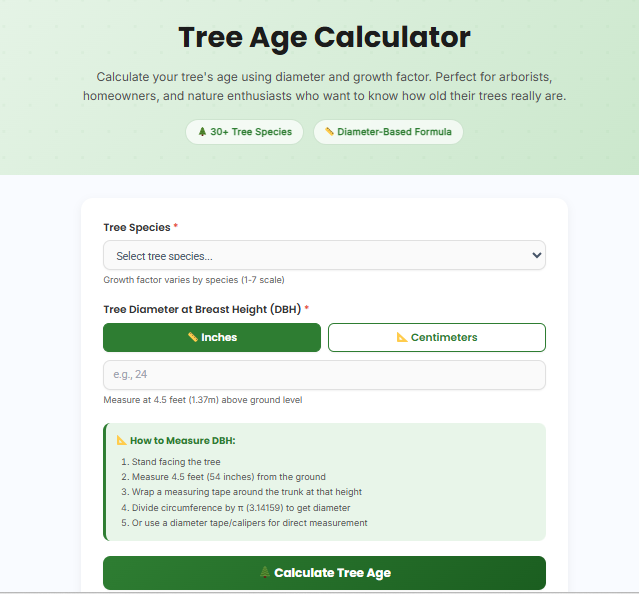
Calculate your tree's age using diameter and growth factor. Perfect for arborists, homeowners, and nature enthusiasts who want to know how old their trees really are.
🌳 Tree Age Estimated
💡 Note: This is an estimate based on diameter and growth factor. Actual age may vary due to growing conditions, climate, soil quality, and tree health. For precise dating, consider dendrochronology (tree ring counting).
How the Tree Age Calculator Works
Step 1
Select your tree species from 30+ options
Step 2
Choose measurement unit (inches or centimeters)
Step 3
Measure diameter at breast height (4.5 feet up)
Step 4
Enter diameter and click Calculate
Step 5
View estimated age + life stage + calculation details
Why Use Our Tree Age Calculator
30+ Tree Species
Covers hardwoods, softwoods, fast-growing, and ornamental trees
DBH Formula
Uses industry-standard Diameter at Breast Height method
Growth Factor Based
Accurate species-specific growth factors (1-7 scale)
Dual Units
Works with inches or centimeters — your choice
Instant Results
Get estimated age, life stage, and calculation breakdown
100% Private
No data stored — all calculations in your browser
The Science Behind Tree Age Estimation
Tree age estimation combines forestry science, dendrochronology (tree ring analysis), and species-specific growth patterns. Our calculator uses the DBH method — a non-invasive approach trusted by arborists worldwide.
📏 DBH Method
Diameter at Breast Height (DBH) is the standard forestry measurement taken at 4.5 feet (1.37m) above ground. This height avoids trunk irregularities near the base while providing consistent, comparable data. The International Society of Arboriculture (ISA) recognizes DBH as the industry standard for tree assessment.
🌲 Growth Factors
Each tree species grows at different rates. Growth factors range from 1 (very slow, like oak) to 7 (fast, like Douglas fir). These factors are derived from decades of forestry research by organizations like the USDA Forest Service and university forestry departments, accounting for average growing conditions.
🔬 Dendrochronology
For exact age, scientists use dendrochronology — counting tree rings in a core sample. Each ring represents one year of growth. While our calculator provides non-invasive estimates, tree ring analysis can date trees to the exact year and reveal climate history, droughts, and forest fires.
📚 Trusted Forestry Sources
- International Society of Arboriculture (ISA) — DBH measurement standards
- USDA Forest Service — Tree growth rate research
- American Forests — National champion tree database
- University Forestry Programs — Species-specific growth factor studies
- Arbor Day Foundation — Tree identification and aging guidelines
🌳 Fun Fact: The oldest known tree is a Great Basin Bristlecone Pine in California named "Methuselah" — it's over 4,800 years old! That means it was already ancient when the Egyptian pyramids were built.
Tree Growth Factors by Species
| Growth Rate | Growth Factor | Tree Species Examples |
|---|---|---|
| 🐢 Very Slow | 1.0 - 2.0 | White Oak, Red Oak, American Beech, Cottonwood |
| 🚶 Slow | 3.0 - 3.5 | American Elm, Black Walnut, Willow, Linden, Sycamore |
| 🏃 Moderate | 4.0 - 5.0 | Sugar Maple, Red Maple, White Ash, Silver Maple, White Pine, Cherry, Redbud |
| 🏎️ Fast | 6.0 - 7.0 | Norway Spruce, Blue Spruce, Douglas Fir, Dogwood, Holly |
ℹ️ Growth factors represent average conditions. Actual growth varies by climate, soil, water, and competition.
🌲 World's Oldest Trees
Methuselah
Species: Great Basin Bristlecone Pine
Age: 4,853 years old
Location: White Mountains, California
Old Tjikko
Species: Norway Spruce
Age: 9,558 years old (root system)
Location: Dalarna, Sweden
General Sherman
Species: Giant Sequoia
Age: 2,300-2,700 years old
Location: California (largest by volume)
Jōmon Sugi
Species: Japanese Cedar
Age: 2,000-7,000 years old
Location: Yakushima Island, Japan
Understanding Tree Age — And Why It Matters
Every tree is carrying its own age record inside its trunk — written in rings of wood that form one by one, year after year. Whether you are a homeowner trying to understand the oak in your backyard, a student studying forestry, or a conservationist assessing heritage trees, knowing a tree’s age tells you far more than just a number. It tells you what that tree has survived — droughts, storms, fires, and centuries of change — and what it might still have ahead of it.
How This Tree Age Calculator Works
This calculator uses the DBH method (Diameter at Breast Height) — the industry standard used by arborists, foresters, and the International Society of Arboriculture worldwide. The formula is simple:
Estimated Age = Trunk Diameter (inches) × Species Growth Factor
To use it correctly, measure your tree’s circumference at exactly 4.5 feet above ground — the standard breast height used in all professional forestry measurements. Divide that circumference by 3.14 to get the diameter, then select your species. The calculator applies the correct growth factor automatically.
What Is a Growth Factor — And Why Does Species Matter?
Growth factors represent the average number of years a tree species takes to grow one inch in diameter under typical conditions. They vary significantly between species because different trees are genetically programmed to grow at different speeds.
| Tree Type | Growth Factor | Growth Speed |
|---|---|---|
| Cottonwood, Silver Maple | 2.0 – 3.0 | Fast |
| Red Oak, Norway Spruce | 4.0 – 4.5 | Moderate |
| White Oak, Sugar Maple | 5.0 | Slow |
| Dogwood, Yew | 7.0+ | Very slow |
A 30-inch diameter Red Oak is estimated at 120 years old (30 × 4.0). The same diameter White Oak would be estimated at 150 years old (30 × 5.0). Species identification before calculating is essential — using the wrong growth factor can throw your estimate off by decades.
How Accurate Is the DBH Method?
The DBH method gives a reliable estimate — not an exact count. Growth factors represent averages across many trees in typical conditions. Individual trees grow faster or slower depending on soil quality, water availability, sunlight, competition from surrounding trees, and local climate.
A tree growing in ideal conditions — rich soil, full sun, no competition — will be younger than the estimate. A tree stressed by drought, poor soil, or harsh mountain climate will be older. For most practical purposes — understanding your yard tree, heritage tree assessment, urban planning, property valuation — DBH estimates are entirely adequate.
For situations requiring exact age — legal disputes, scientific research, formal heritage designation — professional dendrochronology using an increment borer remains the most accurate approach. An increment borer extracts a thin core sample from the living trunk, which is then analyzed under magnification to count rings precisely without cutting the tree down.
What Tree Rings Actually Tell You
Each ring inside a tree trunk represents one full year of growth. A wide ring means that year had good conditions — adequate rainfall, warm temperatures, long growing season. A narrow ring means the tree experienced stress — drought, cold, disease, or competition. A ring with a dark scar marks a year the tree survived a fire.
This is why trees are considered living climate archives. A 500-year-old oak has recorded 500 years of local weather history in its wood — information that climate scientists use to reconstruct conditions from centuries before human record-keeping began. The formal science of reading and dating tree rings is called dendrochronology — one of the most powerful tools in both ecology and archaeology.
Tree Age and Lifespan — What Is Normal for Your Species?
Not all trees age the same way. A Silver Maple at 80 years is entering its final decades. A White Oak at 80 years is still a young tree. Knowing your species’ expected lifespan helps you understand where your tree sits in its life cycle and what care it might need.
Fast-growing species like Cottonwood and Silver Maple live 80 to 125 years on average. Moderate growers like Red Oak and Sugar Maple live 200 to 500 years. Slow growers like White Oak and Yew can live 600 to 1,000 years or more. The Great Basin Bristlecone Pine — the world’s oldest confirmed living tree species — has specimens exceeding 5,000 years in age. These ancient trees grow in harsh, high-altitude environments where slow growth produces exceptionally dense, rot-resistant wood.
Practical Reasons to Know Your Tree’s Age
For homeowners: A 150-year-old oak is in its mature prime but will eventually decline. A 40-year-old maple is entering its most vigorous phase with decades of growth ahead. Age guides decisions about pruning, cabling support, fertilization, and long-term replacement planning.
For property value: Mature trees significantly increase property value — sometimes adding tens of thousands of dollars to a home’s market price. Knowing you have century-old oaks or maples gives you concrete data about these living assets.
For conservation: Ancient trees provide irreplaceable habitat — hollows for nesting birds and mammals, dead wood for beetle and fungal species, deep root networks that stabilize soil and regulate water. Age data helps conservationists identify and protect trees that cannot be replaced within any human lifetime.
For urban planning: Cities use tree age data for canopy coverage calculations, heritage tree designation, succession planning, and urban forestry management.
Want to understand all the methods for calculating tree age — ring counting, increment borer, height estimation, radiocarbon dating — and the science behind why trees live as long as they do?
Frequently Asked Questions
Common questions about calculating tree age using the DBH method and growth factors.
How do you calculate the age of a tree without cutting it down?
The most common non-destructive method is the DBH (Diameter at Breast Height) formula. Measure the tree's diameter at 4.5 feet above ground, then multiply by the species-specific growth factor. For example, a 24-inch oak (growth factor 4.0) is approximately 96 years old (24 × 4 = 96). This provides a reliable estimate without harming the tree.
What is DBH and why is it measured at 4.5 feet?
DBH stands for Diameter at Breast Height. It's measured at 4.5 feet (1.37 meters) above ground because this height avoids the irregular trunk swelling near the base while remaining easily accessible for measurement. This standardization allows consistent comparisons across different trees and has been the forestry industry standard for over a century.
How do I measure tree diameter if I only have a measuring tape?
Wrap the measuring tape around the tree trunk at exactly 4.5 feet above ground to get the circumference. Then divide that number by 3.14159 (π) to calculate the diameter. For example, if the circumference is 75 inches, the diameter is 75 ÷ 3.14159 = 23.9 inches. You can also use a diameter tape or tree calipers for direct diameter readings.
What is a tree growth factor and how is it determined?
A growth factor is the average number of years it takes a tree species to grow one inch in diameter. These factors (ranging from 1.0 to 7.0+) are determined through decades of forestry research by organizations like the USDA Forest Service. Slow-growing trees like oak have low factors (1-2), while fast-growing trees like spruce have higher factors (6-7).
How accurate is the DBH tree age calculator?
The DBH method provides reasonable estimates, typically within 10-20% of actual age for trees growing in average conditions. Accuracy depends on correct species identification and typical growing conditions. For exact ages required for legal or scientific purposes, dendrochronology (counting tree rings from a core sample) is necessary. However, for general knowledge and planning, DBH estimates are quite reliable.
Do all oak trees (or maple, pine, etc.) have the same growth factor?
Similar species within the same genus generally share similar growth factors, but there can be variations. White oak and red oak both have growth factors around 4.0-5.0. Sugar maple and red maple are both around 4.5-5.0. When in doubt, use the average factor for that tree type, or choose the specific subspecies if your calculator offers it.
Why does my tree seem older/younger than the calculator says?
Growth rates vary based on environmental conditions. Trees growing in ideal conditions (rich soil, ample water, full sun) grow faster than average, making them younger than the estimate. Trees in harsh conditions (poor soil, drought, shade, competition) grow slower and are older than estimated. Urban trees often grow faster than forest trees due to less competition and more resources.
Can I use this calculator for fruit trees or ornamental trees?
Yes, if the species is included in our list. However, fruit trees and ornamentals are often pruned, fertilized, and watered differently than wild trees, which can affect growth rates. Dwarf or grafted fruit trees won't follow standard growth factors. For best results, use this calculator on naturally-growing specimens rather than heavily managed ornamentals.
What's the difference between counting rings and using the DBH method?
Counting rings (dendrochronology) provides exact age by counting annual growth rings in a cross-section or core sample. Each ring = one year. This is 100% accurate but requires extracting wood from the tree. The DBH method is non-invasive and provides estimates based on diameter and species, making it practical for living trees you don't want to harm.
How do I identify my tree species before using the calculator?
Use tree identification apps (like PictureThis, Seek, or iNaturalist), field guides, or consult a local arborist. Key identifying features include leaf shape and arrangement, bark texture and color, tree shape/crown, and in some seasons, flowers or fruits. If uncertain between similar species with close growth factors (like different maples), the age estimate will still be reasonably accurate.
Can I calculate the age of a dead or dying tree?
Yes, you can use the DBH method on dead trees as long as you can still measure the trunk diameter accurately. However, if the tree has been dead for years and the wood is decaying or the bark is falling off, measurements may be unreliable. For dead trees, counting rings directly (if you cut it down) provides the most accurate age.
Why do different calculators give me different ages for the same tree?
Different sources use slightly different growth factors based on regional research, climate zones, or specific subspecies variations. A red oak might have a growth factor of 4.0 in one calculator and 4.5 in another. These minor differences reflect the reality that growth rates vary by location and conditions. All reputable calculators should give you results within a similar range.
Should I use inches or centimeters when measuring?
Our calculator accepts both inches and centimeters — simply select your preferred unit before entering the diameter. The formula works the same way regardless of units, as long as you're consistent. Most growth factor research in the United States uses inches, while international forestry typically uses centimeters.
How old does a tree need to be before I can use this calculator?
The DBH method works best on trees that have reached breast height (4.5 feet tall) and have measurable trunk diameter. Very young trees (saplings under 3-4 years old) are better aged by known planting dates. Once a tree has a trunk diameter of at least 1-2 inches at breast height, the calculator provides useful estimates.
Is any personal data saved when I use the tree age calculator?
No. All calculations run entirely in your browser using JavaScript. Your tree measurements, species selections, and results are never stored, tracked, or sent to any server. The calculator is completely private, free, and requires no registration or account.
Updated: March 29, 2026