
Sleep Calculator
Find the best time to wake up or go to bed based on sleep cycles. Our Sleep Calculator uses the 90-minute sleep cycle method to help you wake up refreshed not groggy!
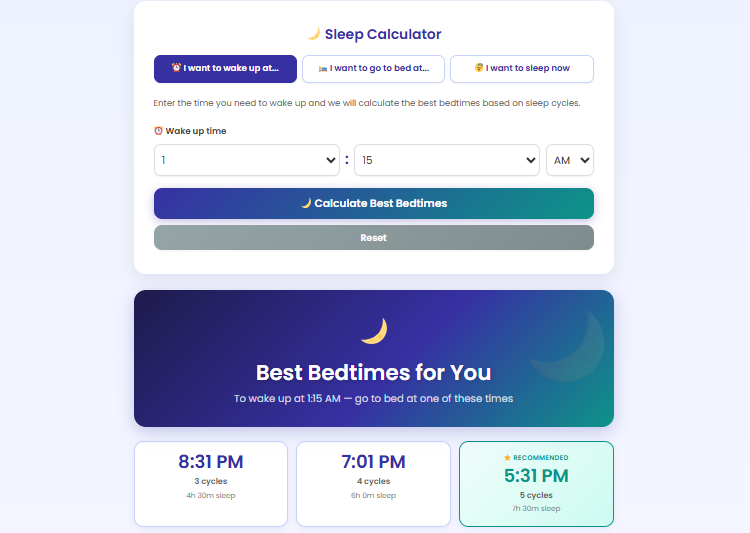
🌙 Sleep Calculator
Enter the time you need to wake up and we will calculate the best bedtimes based on sleep cycles.
How the Sleep Calculator Works
Step 1
Choose your mode — wake up time, bedtime, or sleep now
Step 2
Enter your target wake up time or bedtime
Step 3
We calculate times based on 90-minute sleep cycles
Step 4
Wake up refreshed at the end of a complete cycle
Why Use Sleep Calculator
Sleep Cycle Science
Based on the 90-minute sleep cycle — wake up at the end of a cycle instead of the middle to feel refreshed
Three Calculation Modes
Calculate from wake up time, from bedtime, or from right now — all three modes fully supported
Fall Asleep Offset
Automatically accounts for the average 14 minutes it takes a person to fall asleep after lying down
Multiple Options
Get 6 different optimal sleep times so you can choose the one that best fits your schedule
Sleep Quality Tips
Get personalized sleep quality tips based on your sleep duration and recommended sleep hygiene practices
Mobile Friendly
Works perfectly on all devices — phone, tablet and desktop with instant results
Most people think sleep is simple — close your eyes, drift off, and wake up when the alarm rings. But the science of sleep is far more complex and fascinating than that. The quality of how you feel when you wake up is not just about how many hours you slept. It depends almost entirely on when in your sleep cycle you wake up. Waking up at the wrong moment in your sleep cycle can leave you feeling groggy, foggy, and exhausted even after a full eight hours — while waking up at the right moment after just six hours can leave you feeling completely refreshed.
What Is a Sleep Cycle?
A sleep cycle is a repeating sequence of sleep stages that your brain and body cycle through during the night. Each complete sleep cycle lasts approximately 90 minutes and consists of four distinct stages. The first three stages are Non-REM sleep — progressing from light sleep to deep slow-wave sleep. The fourth stage is REM (Rapid Eye Movement) sleep, where most dreaming occurs and where emotional memory consolidation and creativity processing take place.
Throughout a typical night, you cycle through approximately 4 to 6 complete sleep cycles. The composition of each cycle changes as the night progresses — early cycles have more deep slow-wave sleep while later cycles have more REM sleep. This is why sleeping a full night gives you both physical restoration (from deep sleep) and mental restoration (from REM sleep).
The Four Stages of Sleep
Stage 1 (N1) is the lightest stage of sleep — the transition between wakefulness and sleep lasting just 1 to 7 minutes. Your muscles begin to relax and you may experience hypnic jerks. Stage 2 (N2) is light sleep where your heart rate slows, body temperature drops, and sleep spindles appear in your brain waves. This stage accounts for about 50 percent of your total sleep time. Stage 3 (N3) is deep slow-wave sleep — the most physically restorative stage where growth hormone is released, muscles repair, and the immune system strengthens. Stage 4 (REM) is where dreaming occurs and the brain processes emotions, consolidates memories, and enhances learning and creativity.
😴 Waking Mid-Cycle
Interrupted from deep sleep. Severe grogginess, brain fog, impaired judgment and low energy — even after many hours of sleep. Called sleep inertia.
✅ Waking End of Cycle
Natural light sleep transition. Feel alert, refreshed and energized even with fewer total hours. Memory consolidation and processing complete.
How Much Sleep Do You Actually Need?
The National Sleep Foundation recommends 7 to 9 hours of sleep per night for adults aged 18 to 64, and 7 to 8 hours for adults aged 65 and older. Teenagers need 8 to 10 hours and school-age children need 9 to 11 hours. However, these are averages — individual sleep needs vary significantly based on genetics, activity level, health status, and lifestyle. The key is not just total hours but ensuring you complete enough full 90-minute sleep cycles.
In terms of sleep cycles, most adults need 5 to 6 complete cycles per night — equivalent to 7.5 to 9 hours of sleep. Four cycles (6 hours) is generally the minimum for maintaining basic cognitive function, while three cycles (4.5 hours) is considered sleep deprivation territory for most people. If you want to understand exactly which wake-up time will help you feel your best, our detailed guide on the best time to wake up covers the optimal wake-up windows for different schedules and sleep needs.
Why Morning Grogginess Happens
Sleep inertia is the technical term for that groggy, disoriented feeling you experience immediately after waking. It occurs when you are jolted out of deep slow-wave sleep rather than waking naturally at the end of a light sleep stage. Sleep inertia can last anywhere from 15 minutes to over an hour in severe cases and significantly impairs cognitive performance, reaction time, and decision-making ability during that window.
By using a sleep calculator to time your alarm at the natural end of a 90-minute sleep cycle, you drastically reduce the severity of sleep inertia. This is because at the end of a cycle you are naturally in Stage 1 or transitioning from REM sleep — both very light stages from which waking is natural and gentle rather than abrupt.
Sleep Hygiene Tips for Better Sleep Quality
Knowing the right time to sleep is only half the equation. Sleep hygiene — the habits and environment that support quality sleep — is equally important. Keep your bedroom cool between 65 and 68 degrees Fahrenheit (18 to 20 degrees Celsius), dark, and quiet. Avoid screens at least 60 minutes before bedtime as blue light suppresses melatonin production. Avoid caffeine after 2pm as it has a half-life of 5 to 6 hours. Maintain a consistent sleep and wake schedule even on weekends to keep your circadian rhythm stable.
Calculate Your Perfect Sleep Schedule Now
Use our Sleep Calculator above to instantly find your optimal bedtime or wake-up time based on 90-minute sleep cycles. Choose whether you want to calculate from your wake-up time, your bedtime, or from right now — and get six different optimal sleep windows to choose from. Better sleep starts with better timing.
Frequently Asked Questions
Everything you need to know about Sleep Calculator
How does the sleep calculator work?
Our Sleep Calculator is based on the 90-minute sleep cycle. Each sleep cycle lasts approximately 90 minutes and consists of four stages — light sleep, deep sleep, and REM sleep. Waking up at the natural end of a cycle rather than in the middle dramatically reduces grogginess. The calculator also adds 14 minutes to account for the average time it takes to fall asleep after lying down.
Why do I still feel tired after 8 hours of sleep?
If you feel tired after 8 hours, you likely woke up in the middle of a deep sleep cycle rather than at the end of one. This causes sleep inertia — a feeling of grogginess and impaired alertness. By timing your alarm to the end of a 90-minute sleep cycle, you can wake up feeling much more refreshed even with fewer total hours of sleep.
How many hours of sleep do I need?
Most adults need 7 to 9 hours of sleep per night which equals 5 to 6 complete 90-minute sleep cycles. Teenagers need 8 to 10 hours. Children aged 6 to 12 need 9 to 11 hours. Older adults over 65 typically need 7 to 8 hours. However individual needs vary and the quality of sleep cycles matters as much as total hours.
What are the stages of sleep?
There are four sleep stages in each 90-minute cycle. Stage 1 (N1) is very light sleep lasting 1 to 7 minutes. Stage 2 (N2) is light sleep making up about 50 percent of total sleep time. Stage 3 (N3) is deep slow-wave sleep — the most physically restorative stage. Stage 4 (REM) is where dreaming occurs and the brain processes memories and emotions.
Why does the calculator add 14 minutes?
The 14 minutes accounts for sleep latency — the average time it takes a healthy adult to fall asleep after getting into bed. If you need to wake up at 7am, you should not go to bed at exactly 7am minus your sleep duration — you need an additional 14 minutes to account for the time spent lying awake before actually falling asleep.
Is it better to get 6 hours or 7.5 hours of sleep?
7.5 hours is generally better as it completes 5 full sleep cycles, but 6 hours aligned with cycle endings (4 complete cycles) is often better than 7 hours that cuts a cycle short. The key is completing whole cycles. Waking mid-cycle after 7 hours can feel worse than waking at the end of a cycle after 6 hours for many people.
What is the best time to wake up?
The best time to wake up is at the natural end of a 90-minute sleep cycle — when your body is in light sleep rather than deep sleep. For most people waking between 6am and 8am is ideal as it aligns with the natural rise in cortisol that your body produces in the morning. Consistency matters — waking at the same time every day stabilizes your circadian rhythm.
Can I use this sleep calculator for naps?
Yes. For naps, the ideal duration is either 20 minutes (before entering deep sleep — a power nap) or 90 minutes (one complete sleep cycle). Naps of 30 to 60 minutes often cause grogginess because they cut into deep sleep. The sleep now mode of our calculator works perfectly for calculating nap wake-up times.
Is this sleep calculator free to use?
Yes, completely free. No registration required, no hidden charges, and no premium version needed. Use our Sleep Calculator unlimited times to instantly find your optimal bedtime, wake-up time, or sleep now windows based on complete 90-minute sleep cycles.