
You filled out a government form in Nepal and it asked for your date of birth in BS format. You stared at the field for a moment because your birth certificate shows an AD date, and you are not entirely sure what your BS equivalent is or how the whole system even works.
This happens to thousands of people every day in Nepal students filling SEE forms, professionals applying for Lok Sewa Aayog exams, citizens getting their citizenship certificates, and Nepalis living abroad trying to fill official documents correctly.
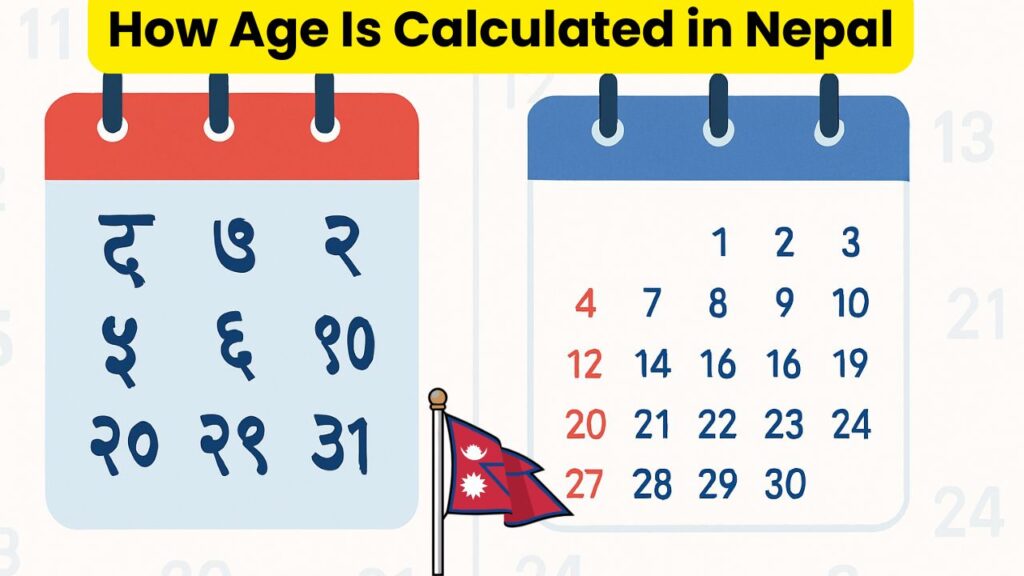
This guide explains everything. How the Bikram Sambat calendar works, why Nepal uses it, how age is officially calculated, what completed age and running age mean, and exactly how to avoid the mistakes that get applications rejected.
Why Nepal Uses a Different Calendar — And What Year It Actually Is
While most of the world calls it 2026, Nepal is living in 2082/2083 BS.
This is not a mistake. Nepal officially uses the Bikram Sambat (BS) calendar — also written as Vikram Samvat (वि.सं.) — as its national calendar for all government, legal, and educational purposes. Every official document in Nepal — citizenship certificates, birth certificates, court records, school certificates, land registration papers, bank statements — uses BS dates exclusively.
The Bikram Sambat calendar is approximately 56 years and 8 months ahead of the Gregorian (AD) calendar. The offset shifts slightly throughout the year:
- January to mid-April: BS is 57 years ahead of AD
- Mid-April onwards: BS is 56 years ahead of AD
This shift happens because the Nepali new year begins in mid-April — not January 1 like the Gregorian calendar.
So right now in March 2026 AD, Nepal is in 2082 BS. When Baisakh 1 arrives on April 14, 2026 AD, Nepal will step into 2083 BS.
The History of Bikram Sambat — Where Did It Come From?
The Bikram Sambat calendar traces its origins to the legendary ancient Indian emperor Vikramaditya of Ujjain, who is said to have established this calendar system to mark his victory over the Shakas around 57 BCE. The calendar has been counting continuously from that starting point — which is why it is now in the year 2082/2083 while the world’s Gregorian calendar, which counts from the birth of Christ, is only at 2026.
Nepal officially adopted the Bikram Sambat calendar as its national civil calendar during the Rana dynasty in 1901 CE — which was the year 1958 BS. Since then, it has been the foundation of all official timekeeping in Nepal.
It is worth noting that there is also a separate Nepal Sambat calendar, counted from 879 CE, which is used by certain communities — particularly the Newari community. However, Bikram Sambat is the state-recognized official calendar and the one used everywhere for government and legal purposes.
How the Bikram Sambat Calendar Works — The Structure
Understanding the structure of the BS calendar helps explain why BS-AD conversion is not as simple as adding or subtracting a fixed number.
It Is a Lunisolar Calendar Adapted Into a Solar System
The original Vikram Samvat is a lunisolar calendar — meaning it uses both the movement of the moon and the sun to calculate dates. In Nepal, this has been adapted into a practical solar calendar for civil use. However, because it still follows astronomical principles rather than fixed mathematical rules, month lengths vary every single year.
Variable Month Lengths
This is the most important structural difference from the Gregorian calendar.
In the Gregorian calendar, January always has 31 days, February has 28 or 29, and so on — fixed and predictable.
In the Bikram Sambat calendar, each month can have 29, 30, 31, or 32 days — and the exact length changes every year based on astronomical calculations. There is no fixed pattern you can memorize. A dedicated calendar committee in Nepal releases updated month lengths every year.
This is precisely why you cannot convert a BS date to AD (or vice versa) by simple arithmetic. You need either a precise lookup table or a calculator built with that table like the one at Nepali Age Calculator.
The 12 Months of Bikram Sambat
The BS calendar has 12 months with unique Nepali names. Here they are in order with their Devanagari script and approximate Gregorian equivalent:
| # | BS Month | Devanagari | Approximate AD Months |
|---|---|---|---|
| 1 | Baisakh | बैशाख | Mid-April to Mid-May |
| 2 | Jestha | जेठ | Mid-May to Mid-June |
| 3 | Ashadh | असार | Mid-June to Mid-July |
| 4 | Shrawan | साउन | Mid-July to Mid-August |
| 5 | Bhadra | भदौ | Mid-August to Mid-September |
| 6 | Ashwin | असोज | Mid-September to Mid-October |
| 7 | Kartik | कार्तिक | Mid-October to Mid-November |
| 8 | Mangsir | मंसिर | Mid-November to Mid-December |
| 9 | Poush | पुष | Mid-December to Mid-January |
| 10 | Magh | माघ | Mid-January to Mid-February |
| 11 | Falgun | फागुन | Mid-February to Mid-March |
| 12 | Chaitra | चैत | Mid-March to Mid-April |
Each BS month starts approximately in the middle of the corresponding Gregorian month — not at the beginning. This mid-month offset, combined with variable day counts, makes precise conversion a task that requires a reliable tool.
Nepali New Year — Naya Barsha (नयाँ वर्ष)
The Bikram Sambat new year begins on 1 Baisakh — which falls on either April 13 or April 14 in the Gregorian calendar depending on the year. This day is a national public holiday in Nepal, celebrated as Naya Barsha (नयाँ वर्ष). In 2026 AD, Baisakh 1 of 2083 BS falls on April 14, 2026.
The new year celebration marks the beginning of spring and the agricultural season. In Bhaktapur, the famous Bisket Jatra festival is held on this day. Across Nepal, people exchange greetings, visit temples, and gather with family to welcome the new year.
BS to AD Conversion — Why It Is More Complex Than You Think
The most common mistake people make is assuming they can convert BS to AD by simply subtracting 57 years. This gives a rough estimate but not an accurate date.
Here is why the conversion is genuinely complex:
The year offset changes twice a year. Before Baisakh 1 (mid-April), the BS year is 57 years ahead of AD. After Baisakh 1, it becomes 56 years ahead. So depending on which month you are in, the offset is different.
Month lengths vary every year. Since BS months do not have fixed day counts, Falgun might have 29 days in one year and 30 days in another. You cannot calculate a BS date equivalent without knowing the exact length of each month for that specific year.
The months do not align with Gregorian months. BS months start mid-month in AD terms. Poush starts in mid-December, Magh in mid-January, and so on.
This is why even a small error in BS-AD conversion can cause major problems on official documents. A one-day difference can change your age eligibility for a government exam or a citizenship application.
How Age Is Officially Calculated in Nepal
Now that you understand the calendar, let us talk about how age is actually calculated for official purposes in Nepal.
Your Age Is Always Calculated in BS — Not AD
In Nepal, your official age is always based on the Bikram Sambat calendar. Even if you know your AD birth date perfectly, what matters on all Nepali government forms is your BS birth date — the one written on your citizenship certificate or birth certificate.
Completed Age (पूरा उमेर) vs Running Age (चल्दो उमेर)
This is the most important distinction in Nepali age calculation — and the one that causes the most confusion among applicants.
Completed Age (पूरा उमेर) is the number of full years you have lived since your birth date. It works exactly like international age — you gain a year on your BS birthday each year.
Example: If you were born on Poush 15, 2053 BS and today is Falgun 20, 2082 BS — your completed age is 28 years because your birthday in 2082 BS (Poush 15) has not happened yet this year.
Running Age (चल्दो उमेर) is the year of life you are currently going through. It is always one number higher than your completed age.
Example: Using the same birth date — if your completed age is 28, your running age is 29 because you are currently living through your 29th year.
Why does this matter?
Many Lok Sewa Aayog (Public Service Commission) job vacancies in Nepal specify age requirements using running age — not completed age. An advertisement might say “minimum running age 21, maximum running age 35.” If you are 34 years old in completed age, your running age is 35 — and you are still eligible. But if you misread the requirement and think your completed age of 34 qualifies for a “maximum age 34” vacancy, you could actually be over the limit.
Always read the job advertisement carefully to identify which type of age is being asked for. When in doubt — check both.
Nepali Age and Official Documents — What You Actually Need to Know
Citizenship Certificate (नागरिकता प्रमाणपत्र)
Your Nepali citizenship certificate records your date of birth in BS format. This is the primary document used for all age verification in Nepal. The BS birth date on your citizenship is the one that counts — not your AD birth date.
If your citizenship shows 2050 Magh 15 BS, that is your official birth date in Nepal — regardless of what your international passport says.
SEE Exam Registration
The Secondary Education Examination (SEE) has strict age requirements. Registration forms require your exact BS birth date as written on your birth certificate or citizenship. The age cutoff is calculated based on a specific BS date determined by the examination board.
Lok Sewa Aayog (Public Service Commission)
Lok Sewa Aayog applications are among the most age-sensitive documents in Nepal. Age limits for government jobs are specified in BS and are checked against the last date of application submission. Both completed age and running age matter depending on the specific vacancy.
Required on Lok Sewa forms:
- Full BS date of birth
- Completed age in years, months, and days as of the application deadline
- Running age in some vacancies
A calculation error here — even by one day — can disqualify an application.
Passport Applications
While passports use the Gregorian (AD) calendar for international validity, the application process in Nepal requires your BS birth date from your citizenship certificate. The embassy or passport office converts it to AD for the passport itself.
Voter Registration
Voter ID registration requires you to be at least 18 years old in completed age as of the voter list cutoff date — calculated in BS.
The Six Seasons of Nepal — Ritu (ऋतु)
The Bikram Sambat calendar is also connected to Nepal’s traditional six-season system called Ritu (ऋतु), inherited from the ancient Vedic calendar tradition. Unlike the four seasons of the Western calendar, Nepal recognizes six seasons of approximately two months each:
| Season | Nepali Name | BS Months | Character |
|---|---|---|---|
| Spring | Basanta (बसन्त) | Falgun–Chaitra | Flowers bloom, mild weather |
| Summer | Grishma (ग्रीष्म) | Baisakh–Jestha | Hot, dry weather begins |
| Monsoon | Barsha (वर्षा) | Ashadh–Shrawan | Heavy rainfall, agriculture peak |
| Autumn | Sharad (शरद) | Bhadra–Ashwin | Clear skies, festival season |
| Pre-winter | Hemanta (हेमन्त) | Kartik–Mangsir | Cool and dry, harvest time |
| Winter | Shishira (शिशिर) | Poush–Magh | Cold, frost in hills |
Your birth Ritu season carries cultural significance in Nepal — particularly in astrology, traditional naming ceremonies, and horoscope readings.
The Role of Bikram Sambat in Nepali Culture
The BS calendar is far more than just a timekeeping system in Nepal. It is woven into the fabric of daily life in ways that make it genuinely irreplaceable.
Festivals and Religious Observances
All major Nepali festivals are scheduled according to the BS calendar and its associated lunar dates (Tithis). Dashain, Tihar, Teej, Maghe Sankranti, Chhath Parva, Holi — none of these have fixed Gregorian dates. They shift every year based on the lunar calendar tied to BS. A Nepali who only knows the Gregorian date would be unable to determine when their most important religious celebrations fall.
Auspicious Dates — Shubha Muhurta (शुभ मुहूर्त)
In Nepal, major life decisions are often made on auspicious dates selected by a Jyotish (astrologer) using the BS calendar. Weddings, house-warming ceremonies, starting new businesses, naming newborns, and even farming activities are scheduled based on Tithis and planetary positions in the BS system. A dedicated calendar committee releases auspicious dates annually.
Nepali Astrology — Jyotish (ज्योतिष)
Traditional Nepali astrology is entirely based on the BS calendar and lunar calculation. Birth horoscopes, compatibility readings, and fortune predictions all use your BS birth date — not your AD date. Your BS birth date is what a Jyotish uses to draw up your natal chart.
National Identity
Nepal’s continued use of the BS calendar is a source of national pride and cultural identity. When the rest of the world is in 2026, Nepal is in 2082/2083 — a visible daily reminder that Nepal has its own distinct historical and cultural timeline. For many Nepalis, this is not an inconvenience but a point of connection to their heritage.
Common Mistakes People Make With Nepali Age Calculation
Mistake 1 — Using Simple Arithmetic for BS-AD Conversion
The most common error. Adding or subtracting 57 years from your birth year gives a rough estimate but not the exact BS date. The actual conversion requires a precise lookup table because BS month lengths change every year. For any official document, always use a verified conversion tool.
Mistake 2 — Confusing Completed Age and Running Age
Many Lok Sewa applicants submit the wrong type of age and face rejection. Read every vacancy announcement carefully. If it says “उमेर” without specifying, clarify with the relevant office. When in doubt, note both your completed age and running age.
Mistake 3 — Using AD Birth Date on BS Forms
Your AD birth date and your BS birth date are different dates — not just different numbers for the same date. January 15, 1990 AD is not the same as writing 1990 in the BS year field. Your BS birth date is approximately Poush 1, 2046 BS — a completely different set of numbers.
Mistake 4 — Assuming the Year Offset Is Always the Same
The BS-AD gap is 57 years from January to mid-April and 56 years from mid-April onwards. People born in January or early February often calculate using the wrong offset and end up with an incorrect BS year.
Mistake 5 — Ignoring the Day Discrepancy
Even if the year and month conversion is correct, the day can be off because BS months start in the middle of Gregorian months. A birth on April 5, 1995 AD falls in Chaitra — the last month of BS 2051, not Baisakh 2052. Getting the month wrong changes the entire age calculation.
Practical Tips for Working With Nepali Dates
Always carry both dates. Note your birth date in both BS and AD format. Write it down somewhere reliable: “Born Poush 15, 2053 BS (December 30, 1996 AD).” This saves recalculation every time.
Use your citizenship certificate as the primary reference. The BS birth date printed on your citizenship is your official date. When filling any Nepali government form, use this date exactly as printed — do not recalculate from your passport.
For international documents, convert carefully. When applying for foreign visas, overseas university admissions, or WES/ECE evaluations, you need to convert your BS birth date to AD accurately. Use a verified tool and double-check the result.
Know the current BS year. Right now it is 2082 BS (Chaitra). Baisakh 1, 2083 BS begins on April 14, 2026 AD. After that date, the BS year becomes 2083.
For Lok Sewa forms, calculate both ages. Calculate your completed age (पूरा उमेर) and running age (चल्दो उमेर) before submission. Check the advertisement again to confirm which is required.
Bikram Sambat vs Gregorian Calendar — Side by Side
| Feature | Bikram Sambat (BS) | Gregorian (AD) |
|---|---|---|
| Current year | 2082/2083 | 2026 |
| New year date | Baisakh 1 (mid-April) | January 1 |
| Month lengths | Variable 29–32 days | Mostly fixed (28–31) |
| Based on | Solar + astronomical | Solar only |
| Used officially in Nepal | Yes — all documents | No — international only |
| Used for festivals | Yes | No |
| Used for astrology | Yes | No |
| Year ahead of AD | 56–57 years | — |
The Bikram Sambat calendar is not just a timekeeping system — it is the foundation of official life in Nepal and a living connection to thousands of years of cultural heritage. Understanding how it works, how age is calculated within it, and how to navigate its differences from the Gregorian calendar is practical knowledge that every Nepali — and anyone dealing with Nepali documents — genuinely needs.