
Age feels universal until you encounter Korea.
You ask someone their age and the number feels wrong. A baby is already one year old. Everyone seems to age overnight on January 1. And two people born months apart confidently say they are the same age.
This confusion is not your fault.
Korea follows a traditional age calculation system that works very differently from the international method most of the world uses. Once you understand the logic behind it, the system becomes simple, predictable, and surprisingly practical.
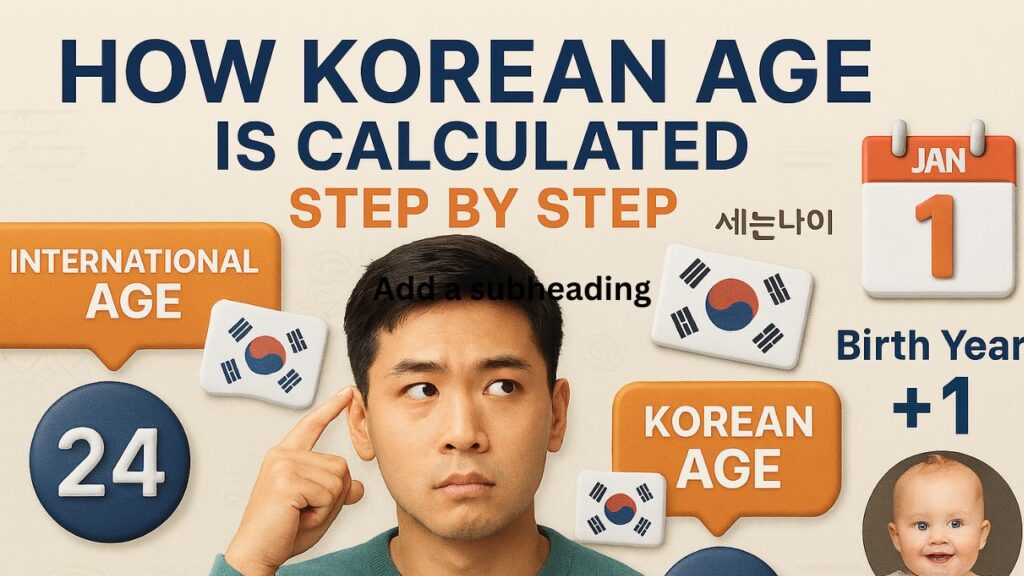
In this guide, you will learn how Korean age is calculated step by step, why it exists, how it differs from international age, and how to calculate your own Korean age correctly in seconds.
What Is the Korean Age System?
The Korean age system is known as 세는나이 (se-neun-nai). It is a traditional method of counting age based on birth year rather than exact birth date.
Under this system:
- You are 1 year old at birth
- Everyone gets one year older on January 1, regardless of their birthday
This means age is tied to the calendar year, not the day you were born.
Why Korea Uses a Different Age Calculation
The Korean age system did not appear randomly. It developed from cultural, historical, and social needs.
1. Life starts before birth
Traditionally, Koreans believed life begins at conception. Time spent in the womb counted as part of a person’s life, which explains why newborns start at one year old.
2. Simpler social organization
In the past, tracking exact birthdates was difficult. A shared age increase on New Year’s Day made it easier to organize schools, taxes, and social roles.
3. Strong age-based hierarchy
Age plays a major role in Korean language, respect, and relationships. A year-based system helped define social order clearly.
How Korean Age Is Calculated Step by Step
This is the core of the system. There are only two rules.
Step 1: Start at 1 year old
In the Korean age system, there is no age zero.
- The moment a baby is born, they are considered 1 year old
- This is different from international age, where a newborn starts at 0
Example:
- Baby born today → Korean age = 1
Step 2: Add one year on January 1
Instead of aging on your birthday, everyone in Korea gains one year on January 1.
- It does not matter if your birthday is in January or December
- Everyone ages together at the start of the year
Example:
- Baby born on December 30
- Two days later, on January 1
- Korean age becomes 2 years old
This is why Korean age can feel much higher than expected.
How to Calculate Your Korean Age Instantly
If you do not want to use the formula manually, you can calculate it instantly using a dedicated tool.Try this Korean Age Calculator
It converts your birthdate into Korean age accurately within seconds and avoids mistakes.
Korean Age Formula Explained Simply
You can calculate Korean age using this simple formula:
Korean Age = Current Year − Birth Year + 1
Example
If you were born in 1999 and the current year is 2025:
2025 − 1999 + 1 = 27 years old (Korean age)
This formula works regardless of whether your birthday has passed.
Real-Life Examples of Korean Age Calculation
Example 1: Born in January
- Birthdate: January 5, 2000
- Year: 2025
- Korean age: 26
Your international age may also be 25 or 26, depending on the date.
Example 2: Born in December
- Birthdate: December 20, 2000
- Year: 2025
- Korean age: 26
Even if your birthday just passed, you share the same Korean age as someone born in January.
Example 3: Same birth year, same age
Two people born in March and November 2003 will have the same Korean age, even though their international ages differ.
Korean Age vs International Age
International Age (만나이)
- Start at 0 at birth
- Age increases on your birthday
- Used globally and legally
Korean Age (세는나이)
- Start at 1 at birth
- Age increases on January 1
- Used socially and traditionally
Key difference
Korean age is usually 1 to 2 years higher than international age.
Types of Age Systems Used in Korea
Korea actually uses more than one age system.
1. Korean Age (세는나이)
- Used in daily conversation
- Common among older generations
2. International Age (만나이)
- Used in law, hospitals, and official documents
- Became the legal standard nationwide
3. Year Age (연나이)
- Calculated as current year minus birth year
- Used in schools and military grouping
Korean Age in Modern Korea
In recent years, Korea officially adopted international age for legal purposes.
What changed:
- Legal documents now use international age
- Medical and government records follow global standards
What did not change:
- Social conversations still use Korean age
- Many people casually refer to Korean age out of habit
So you may hear two different ages depending on context.
Common Confusions About Korean Age
Why do Koreans sometimes give two ages?
They are switching between social age and legal age depending on the situation.
Is Korean age disappearing?
No. It is used less officially, but still deeply rooted socially.
Should foreigners use Korean age?
In casual conversations, yes. In official settings, use international age.
Frequently Asked Questions (FAQs)
Why is a baby one year old in Korea?
Because time in the womb is traditionally counted as part of life.
Do Koreans celebrate birthdays?
Yes. Birthdays are celebrated normally, even though age changes on January 1.
At what age are Koreans considered adults?
Legally, adulthood is based on international age, not Korean age.
Is Korean age always higher?
Usually yes, by one or two years compared to international age.
Key Takeaways
- Korean age starts at 1, not 0
- Everyone ages on January 1
- Korean age is based on birth year, not birthday
- Korea now uses international age legally, but Korean age socially
- Understanding Korean age helps you understand Korean culture
Final Thoughts
Learning how Korean age is calculated step by step is more than solving a math problem. It helps you navigate conversations, relationships, and cultural expectations in Korea without confusion or awkward moments.
Once you understand the logic, the system stops feeling strange and starts making sense.