
Chinese age, known as 虚岁 (Xū Suì) or “nominal age,” is a traditional age counting system where you’re born at age 1 and everyone ages together on Lunar New Year instead of individual birthdays. This makes Chinese age typically 1-2 years higher than your international age.
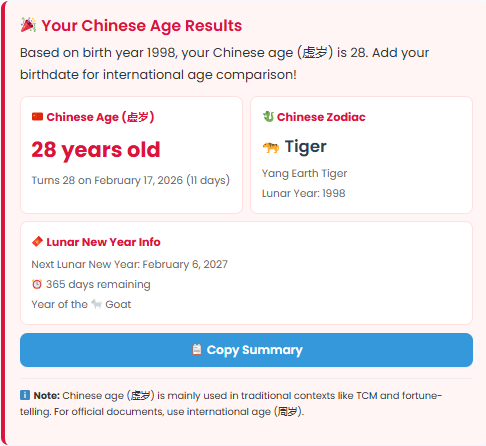
Unlike the Western system where you start at zero and age on your birthday, the Chinese age system follows the lunar calendar. If you were born just before Lunar New Year, you could be 2 years old in Chinese age within weeks of birth!
For a comprehensive understanding of how this traditional system works, read our detailed guide on the Chinese age system.
How Chinese Age Calculation Works
The basic formula for Chinese age is:
Chinese Age = (Current Lunar Year − Lunar Birth Year) + 1
However, it’s more complex than it appears because Lunar New Year falls on different dates each year (between January 21 and February 20). This means your lunar birth year might differ from your Gregorian birth year.
Example: Someone born on January 15, 2000 was actually born in the Lunar Year 1999 (Year of the Rabbit) because Lunar New Year 2000 didn’t arrive until February 5, 2000. This affects their Chinese age and zodiac animal.
The calculator above handles all these complexities automatically, determining your correct lunar birth year and calculating your precise Chinese age.
Chinese Age vs International Age
The key differences between these two systems:
- Chinese Age (虚岁): Starts at 1 at birth, increases on Lunar New Year (lunar calendar)
- International Age (周岁): Starts at 0 at birth, increases on your birthday (Gregorian calendar)
Chinese age can be 1-2 years higher depending on when your birthday falls relative to Lunar New Year. For example, a baby born on January 25, 2026 (before Lunar New Year on February 17) would be:
- Chinese Age: 2 years old (born in 2025, LNY passed = 2026)
- International Age: 0 years old (not yet reached first birthday)
For accurate international age calculations with exact days and months, use our age calculator.
Chinese Age vs Korean Age: Key Differences
While both systems start at age 1 at birth, they have crucial differences. Korean age increases on January 1st (Gregorian calendar) for everyone, making it simpler to calculate. Chinese age increases on Lunar New Year, which changes annually.
Comparison:
- Calendar Used: Chinese age follows the lunar calendar, Korean age follows the Gregorian calendar
- Aging Date: Chinese age on Lunar New Year (varies), Korean age on January 1 (fixed)
- Complexity: Chinese age requires lunar calendar conversion, Korean age uses simple formula
- Zodiac: Chinese zodiac based on lunar year, Korean zodiac based on lunar year too
Both systems can make you appear the same age or slightly different depending on when Lunar New Year falls each year.
Discover the detailed differences and similarities at Chinese age vs Korean age.
Understanding Lunar Age
Lunar age is another term often used interchangeably with Chinese age, though they have subtle distinctions. Lunar age specifically refers to age calculated according to the lunar calendar cycle, emphasizing the connection to moon phases and traditional Chinese calendar systems.
The lunar calendar has been central to Chinese culture for thousands of years, influencing everything from agriculture to festivals to age counting. This is why Chinese age is intrinsically tied to Lunar New Year rather than the Western January 1st.
Learn more about how the lunar calendar affects age calculations at what is lunar age.Expecting a baby? Use your Chinese lunar age to predict your baby’s gender with our Chinese Pregnancy Chart 2026 — Mother’s Lunar Age Predictor.
Chinese Zodiac and Your Age
Your Chinese zodiac animal is determined by your lunar birth year, not your Gregorian birth year. This is a common source of confusion. The 12-year zodiac cycle includes:
🐀 Rat | 🐂 Ox | 🐅 Tiger | 🐇 Rabbit | 🐉 Dragon | 🐍 Snake | 🐴 Horse | 🐐 Goat | 🐒 Monkey | 🐓 Rooster | 🐕 Dog | 🐖 Pig
Important: If you were born between January 1 and Lunar New Year in any given year, your zodiac animal belongs to the previous year.
Example: Born January 20, 2000 (Gregorian) = Rabbit 🐇 (Lunar Year 1999), not Dragon (2000)
The calculator above automatically determines your correct zodiac animal based on your birth date and Lunar New Year timing.
Where Chinese Age is Still Used Today
Despite China officially adopting international age for legal purposes, Chinese age remains relevant in:
Traditional Contexts:
- Traditional Chinese Medicine (TCM) – practitioners may reference Chinese age for treatments
- Fortune telling and astrology (八字 BaZi, 紫微斗数 Zi Wei Dou Shu)
- Feng Shui consultations
- Traditional ceremonies and rituals
Cultural Settings:
- Elderly generations and rural communities
- Family gatherings and ancestral worship
- Cultural festivals celebrating lunar calendar
- Zodiac-based compatibility matching
NOT Used For:
- Official government documents (China, Taiwan, Hong Kong, Singapore)
- Medical records and hospital documentation
- School enrollment and educational records
- Legal contracts and employment
- Passport and visa applications
Why Chinese Age Appears Higher
Two specific factors make Chinese age seem older:
- Born at Age 1: You’re already 1 year old at birth instead of 0, acknowledging the prenatal period as part of your life
- Lunar New Year Timing: Everyone ages together when Lunar New Year arrives, not on individual birthdays
This creates situations where babies born shortly before Lunar New Year can be 2 years old in Chinese age within just days or weeks of life, while their international age remains 0.
Practical Tips for Using Chinese Age
When engaging with Chinese culture or Chinese communities:
In Conversation: If someone mentions age in a traditional context, they might mean Chinese age. Clarify which system they’re referencing to avoid confusion.
Official Documents: Always use international age (周岁) for legal paperwork, visa applications, medical forms, and government documents—Chinese age (虚岁) is not accepted.
Cultural Events: Traditional celebrations, zodiac readings, TCM consultations, or feng shui may reference Chinese age, so knowing both your Chinese and international age is helpful.
Zodiac Compatibility: When checking Chinese zodiac compatibility for relationships or fortune-telling, ensure you’re using the correct lunar birth year.
Understanding Your Calculator Results
When you calculate your Chinese age using the tool above, keep these points in mind:
It’s Traditional, Not Wrong: If your Chinese age seems 1-2 years higher than expected, that’s correct according to the traditional system that’s been used for thousands of years.
Lunar Calendar Matters: Your birth date’s relationship to Lunar New Year determines your lunar birth year, which affects both your Chinese age and zodiac animal.
Context is Key: Use Chinese age for cultural understanding and traditional contexts, but always use international age for official purposes.
Both Systems are Valid: There’s no single “correct” age system—each serves its purpose in different contexts and cultural frameworks.
Cultural Significance of Chinese Age
The Chinese age system reflects deep cultural values that have shaped East Asian societies for millennia:
Respect for Prenatal Life: Starting at age 1 honors the nine months of pregnancy as the beginning of life’s journey, not just the moment of birth.
Lunar Calendar Connection: The system maintains connection to traditional astronomy, agriculture, and the cycles of nature that guided ancient Chinese civilization.
Collective Experience: Everyone aging together on Lunar New Year emphasizes community and shared experiences over Western individualism.
Ancestral Continuity: Using Chinese age connects modern generations to thousands of years of tradition and cultural heritage.
Final Thoughts
The Chinese age system offers fascinating insight into Chinese culture and the values that have shaped one of the world’s oldest continuous civilizations. While China and other Chinese-speaking regions have officially adopted international age for legal purposes, understanding Chinese age remains culturally important for anyone engaging with Chinese culture, studying traditional practices, or building relationships within Chinese communities.
The calculator above makes it simple to discover your Chinese age instantly, along with your Chinese zodiac animal and element. Whether you’re exploring Chinese astrology, planning to visit China, learning about traditional Chinese medicine, or simply curious about different cultural perspectives on age, knowing your Chinese age helps you better understand and appreciate this rich aspect of Chinese tradition.
Try the calculator now to find your Chinese age and discover how the lunar calendar shapes this unique way of measuring life’s journey.