
Death Age Calculator
Estimate your life expectancy based on your age, gender, lifestyle and health factors. Our Death Age Calculator uses evidence-based actuarial data and health science to give you a personalised longevity estimate and actionable tips to live longer.
⏳ Death Age Calculator
Enter your basic information to get a quick life expectancy estimate based on global actuarial data and demographic statistics.
How the Death Age Calculator Works
Step 1
Choose your mode — basic estimate, lifestyle factors, or full health profile
Step 2
Enter your birth date, sex, lifestyle habits and health conditions
Step 3
Our calculator applies actuarial and epidemiological adjustments to your baseline
Step 4
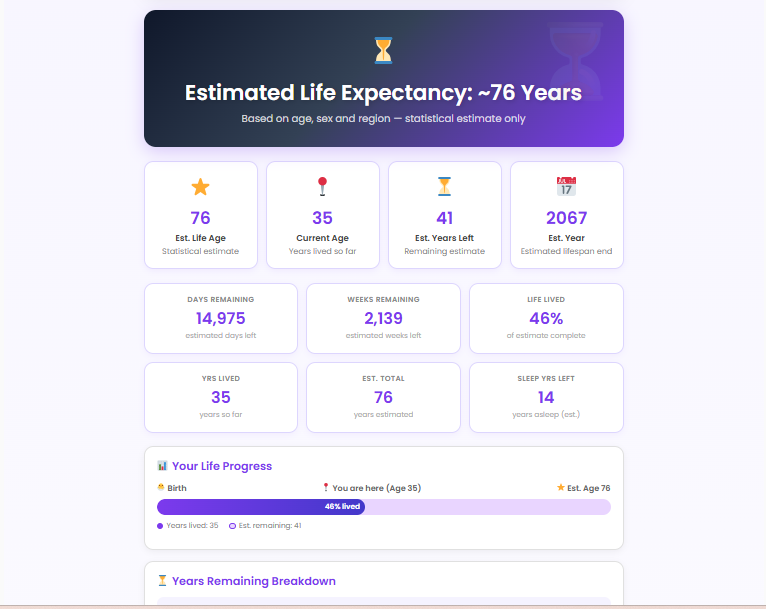
View your personalised estimate with actionable tips to extend your lifespan
Why Use Death Age Calculator
Evidence-Based Data
Built on peer-reviewed actuarial tables and epidemiological research — the same data used by insurance companies and health researchers worldwide
Lifestyle Adjustments
Goes beyond basic demographics to factor in smoking, exercise, diet, sleep and stress — the real drivers of longevity according to modern health science
Health Profile Mode
Include your BMI, existing health conditions and family history for the most personalised life expectancy estimate available in a free online tool
Visual Life Progress
See your life as a progress bar — how much you have lived and how much estimated time remains — to give your result real perspective and meaning
Actionable Tips
Every result includes personalised longevity tips based on your specific inputs — so you can take immediate steps to improve your estimated lifespan
Private and Free
No data stored, no sign-up required, completely free. Your health information stays on your device and is never sent to any server
Life expectancy is one of the most studied statistics in human history — and one of the most misunderstood. When scientists say the average life expectancy in a country is 75 years, they do not mean most people die at 75. They mean that accounting for everyone including infant mortality and early-life deaths, the average across the entire population is 75. An adult who has already reached the age of 50 has a very different remaining life expectancy than this headline figure suggests. Our Death Age Calculator accounts for your current age, sex, lifestyle and health to give you a far more personalised and meaningful estimate.
What Is Life Expectancy and How Is It Calculated?
Life expectancy is a statistical measure — specifically the average number of years a person born in a given year is expected to live, assuming current mortality rates remain constant. Actuaries — the mathematicians who work for insurance companies — have refined this calculation for over two centuries using what are called life tables or mortality tables. These tables track the death rates of large populations across every age group, sex and country.
Modern life expectancy calculations have grown significantly more sophisticated, incorporating dozens of variables beyond simple demographics. Smoking status, physical activity level, diet quality, BMI, sleep duration, stress levels, socioeconomic status and existing health conditions are all now understood to have measurable, quantifiable effects on expected lifespan. Our calculator incorporates adjustments based on the best available evidence for each of these factors.
The Biggest Factors That Affect How Long You Live
Genetics accounts for approximately 20 to 30 percent of longevity variation between individuals — meaning lifestyle and environment account for 70 to 80 percent. This is encouraging news because it means most of what determines your lifespan is within your control. Smoking is the single most impactful negative lifestyle factor — heavy lifelong smokers lose an average of 10 years of life expectancy compared to non-smokers. Regular physical activity is the single most impactful positive factor, with studies consistently showing that active adults live 3 to 7 years longer than sedentary ones.
Sleep is a dramatically underrated longevity factor. Adults who consistently sleep fewer than 6 hours per night have significantly higher rates of cardiovascular disease, obesity, diabetes and all-cause mortality. Diet quality — particularly the Mediterranean diet — is associated with up to 4 additional years of life expectancy in large longitudinal studies. Social connection and strong relationships are among the most powerful longevity predictors, with isolation carrying health risks comparable to smoking 15 cigarettes per day according to research from Brigham Young University.
📉 Factors That Reduce Lifespan
Heavy smoking (−10 yrs), obesity class II+ (−8 yrs), physical inactivity (−5 yrs), chronic stress (−3 yrs), heavy alcohol (−3 yrs), under 5 hrs sleep (−3 yrs).
📈 Factors That Extend Lifespan
Regular exercise (+5 yrs), Mediterranean diet (+4 yrs), healthy BMI (+3 yrs), strong social ties (+7 yrs), 7–8 hrs sleep (+2 yrs), purpose and meaning (+7 yrs).
The Blue Zones — Where People Live Longest
Researchers studying the world's longest-lived populations have identified five geographic clusters called Blue Zones — regions where people routinely live past 100 at rates far above the global average. These are Sardinia in Italy, Okinawa in Japan, Nicoya in Costa Rica, Ikaria in Greece, and Loma Linda in California. Despite their geographic diversity, Blue Zone populations share remarkably consistent lifestyle patterns: predominantly plant-based diets, daily natural movement, strong community bonds, clear sense of purpose, moderate alcohol consumption and low chronic stress levels.
The Blue Zone research, pioneered by Dan Buettner in collaboration with National Geographic and the National Institute on Aging, has fundamentally shifted how scientists understand longevity. It demonstrated that extreme old age is not primarily a matter of luck or genetics — it is largely the result of consistent daily habits embedded in a supportive social environment. Understanding how many days you have already been alive can put these habits in powerful perspective — every day of consistent healthy behaviour compounds over a lifetime.
What to Do With Your Life Expectancy Estimate
The purpose of a death age calculator is not to create anxiety — it is to create clarity. Research in terror management theory and mortality awareness shows that people who engage thoughtfully with their own mortality make better financial decisions, invest more in relationships, pursue more meaningful work and are more likely to adopt healthy behaviours. A life expectancy estimate is most useful as a starting point for reflection: are you spending your time on what truly matters? Are there lifestyle changes you have been meaning to make?
It is also worth noting that life expectancy projections do not account for future medical advances. Gene therapy, AI-driven drug discovery, senolytics and other longevity biotechnologies are advancing rapidly. Many researchers now believe that people alive today in good health have a realistic chance of benefiting from life-extension technologies that do not yet exist. The estimate our calculator gives you is based on current science — your actual lifespan may well exceed it.
Calculate Your Life Expectancy Now
Use our free Death Age Calculator above to get your personalised life expectancy estimate. Start with the Basic mode for a quick result, or use the Lifestyle or Health Profile modes for a more detailed and accurate estimate. Each result includes actionable longevity tips tailored to your specific inputs.
Frequently Asked Questions
Everything you need to know about the Death Age Calculator
What is a Death Age Calculator?
A Death Age Calculator — also called a Life Expectancy Calculator — estimates the age at which a person is statistically likely to die based on their demographics, lifestyle and health factors. It uses actuarial data and epidemiological research to generate a personalised estimate. The result is a statistical estimate, not a medical prediction or guarantee.
How accurate is this life expectancy calculator?
The calculator produces a reasonable statistical estimate based on peer-reviewed research and actuarial data. However no calculator can predict an individual's lifespan with certainty — individual genetics, medical advances, accidents and many other factors are impossible to capture in a general tool. Treat the result as a motivational reference point rather than a precise forecast.
Is my health data stored or shared?
No. All calculations happen entirely in your browser using JavaScript. No data you enter is sent to any server, stored in any database or shared with any third party. Your health information is completely private and disappears when you close the page.
Why does sex affect life expectancy?
Biological sex is one of the most consistent predictors of lifespan across all countries and time periods. Women live an average of 4 to 7 years longer than men in most developed countries. This is attributed to differences in cardiovascular disease risk, hormonal profiles, risk-taking behaviour, healthcare utilisation rates and genetic differences related to the X chromosome.
Can I increase my life expectancy?
Yes — significantly. Since genetics account for only 20 to 30 percent of longevity variation, lifestyle changes can meaningfully extend your expected lifespan. Quitting smoking, exercising regularly, improving diet quality, achieving a healthy BMI, sleeping 7 to 8 hours nightly and managing stress are the highest-impact changes you can make. Even starting these changes in middle age produces measurable benefits.
What is the average life expectancy worldwide?
Global average life expectancy is approximately 73 years as of the most recent WHO data. This varies significantly by country — from over 84 years in Japan and Switzerland to under 60 years in some sub-Saharan African nations. Within countries, life expectancy also varies significantly by sex, socioeconomic status, education level and geographic location.
Why does smoking reduce life expectancy so much?
Heavy lifelong smokers lose an average of 10 years of life expectancy — more than any other single lifestyle factor. Smoking damages nearly every organ in the body, dramatically increasing the risk of lung cancer, heart disease, stroke, COPD and many other cancers. The good news is that quitting at any age produces benefits — quitting before age 40 recovers approximately 9 of those 10 lost years.
Does this calculator replace a doctor's advice?
Absolutely not. This calculator is for educational and motivational purposes only. It is not a medical device, diagnosis tool or substitute for professional medical advice. If you have concerns about your health or lifespan, please consult a qualified healthcare professional who can assess your individual situation properly.
Is the Death Age Calculator free to use?
Yes, completely free. No sign-up, no registration and no payment required. Use all three calculation modes — Basic, Lifestyle and Health Profile — as many times as you like with full results and personalised longevity tips every time.